The phrase "AI-assisted trading" spent several years as the exclusive property of hedge funds and proprietary trading desks. In 2026, that's no longer accurate. The tools that quant firms spent millions building — NLP-based sentiment engines, pattern recognition systems, earnings call parsing models — are now accessible to retail investors through a growing ecosystem of platforms, APIs, and low-cost subscriptions. The question isn't whether AI will touch your investing process. For most systematic investors, it already has. The question is whether you understand what it's actually doing.
The confusion is understandable. The term "AI signal" is used to describe at least four meaningfully different things: (1) large language models parsing news and earnings text for sentiment; (2) machine learning models trained on historical price and volume patterns; (3) alternative data signals — satellite imagery, credit card transactions, job posting data — processed with statistical models; and (4) social media and messaging platform sentiment aggregation, which may or may not involve genuine AI at the parsing layer. Each has different characteristics in terms of signal persistence, decay rate, correlation with existing factors, and susceptibility to crowding.
The conflation of these categories is where most retail engagement with AI signals goes wrong. A sentiment signal derived from parsing 10-Q filings with a well-calibrated LLM operates on fundamentally different timescales — and responds to different market conditions — than a technical pattern-recognition signal trained on five-minute bars. Treating them as interchangeable, or applying the same position sizing logic to both, is the kind of error that produces good-looking backtests and disappointing live results.
What Makes a Signal Persistent vs. Ephemeral
The most important concept in working with any signal — AI-derived or otherwise — is decay. How quickly does the information embedded in a signal get priced in? In efficient markets, exploitable signals decay toward zero as enough capital discovers and acts on them. In practice, signals decay at very different rates, and the decay rate should determine how you size and exit positions built around them.
LLM-derived sentiment signals built on public earnings calls tend to decay within 1-3 trading days for large-cap securities — market participants are fast to process and act on public text. The same signal applied to small-cap earnings calls, where fewer analysts are watching and liquidity is lower, may persist for several weeks. Satellite-based signals — parking lot occupancy as a predictor of retail sales, for example — tended to have decay rates measured in weeks before they became well-known; now, for the specific retailers that funds have been watching for years, the signal-to-noise ratio has compressed substantially.
The practical implication is straightforward: before you act on any AI signal, you need to know its approximate decay rate, the degree of crowding in that signal category, and your position sizing tolerance relative to signal uncertainty. Most retail implementations of AI signals fail not because the signals lack predictive content — many do have genuine alpha — but because they're applied without a validation framework that addresses these three questions systematically.
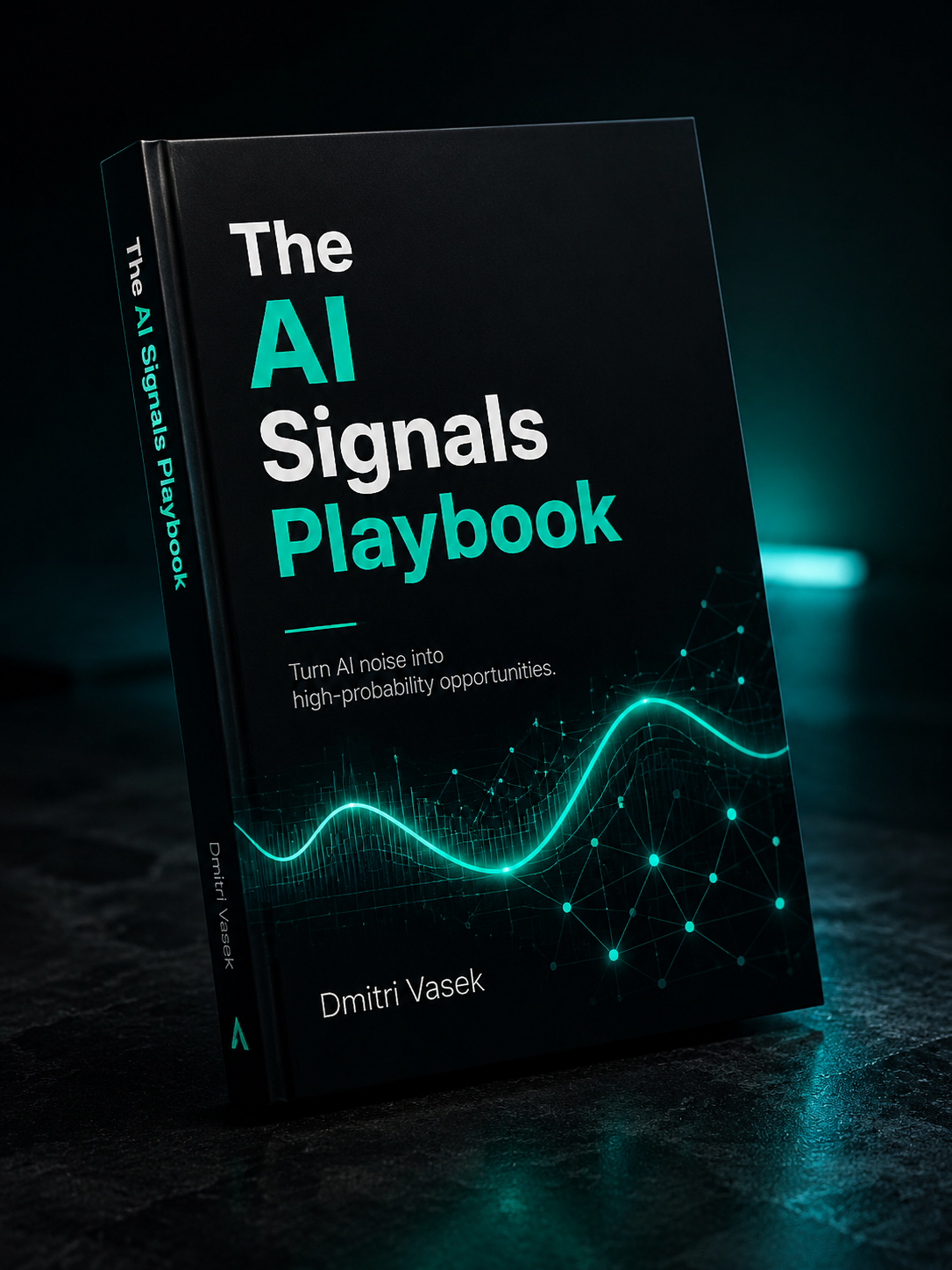
The playbook covers all three dimensions: signal validation methodology, crowding assessment, and position sizing under signal uncertainty. What it doesn't do is promise that AI signals will make you money. They can, when understood and applied rigorously. They absolutely won't, when applied as novelty or with the expectation that the technology does the thinking for you.
Want the full signal framework — including the validation protocol, decay-rate estimation, and the 7 signal categories with worked examples? Download the AI Signals Playbook here. 118 pages, instant download, $59.